

The Role of Artificial Intelligence in the 2026 U.S. Elections
The AI Voter
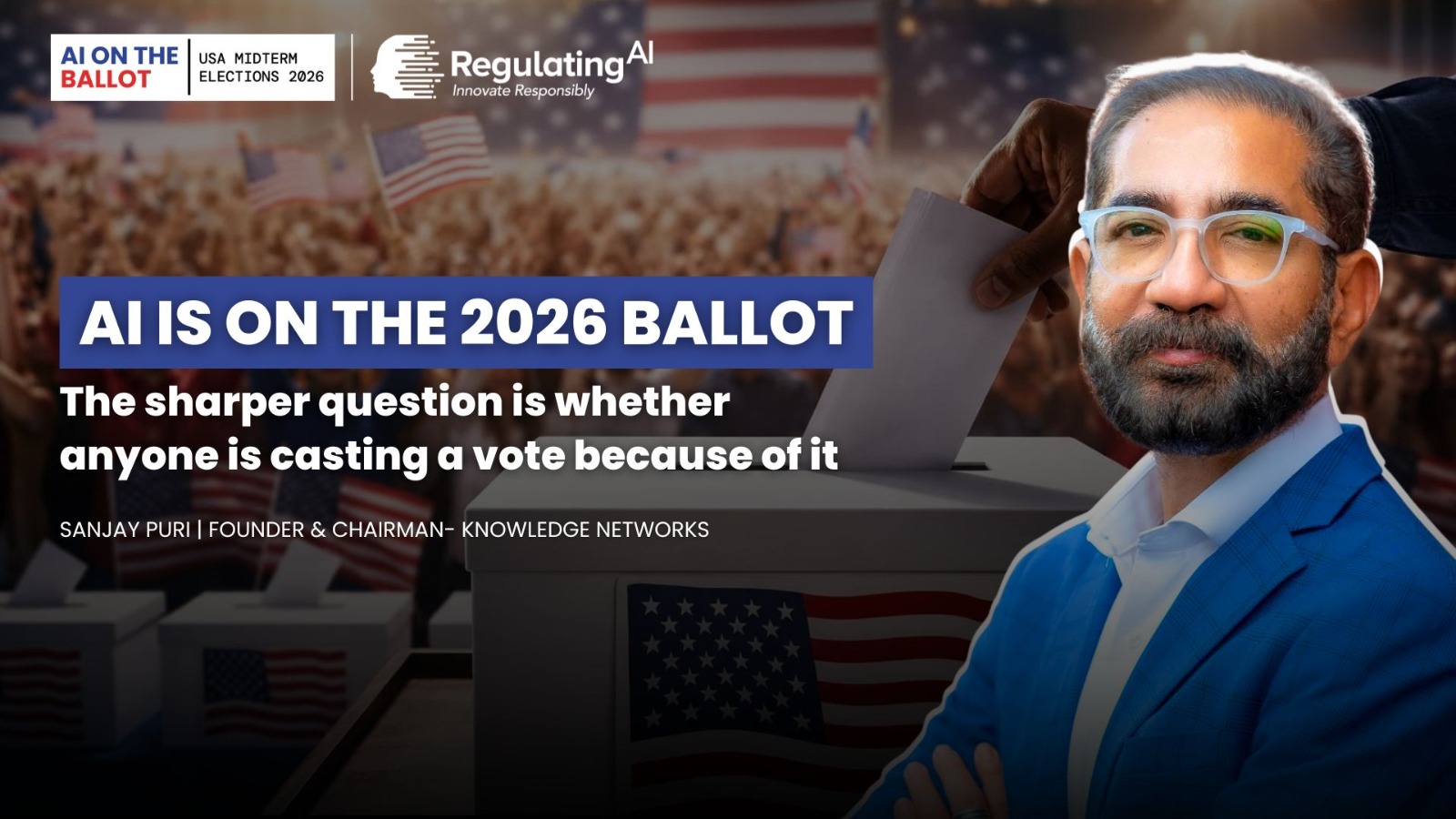
AI is on the 2026 ballot. The sharper question is whether anyone is casting a vote because of it.
WASHINGTON, DC, UNITED STATES, July 8, 2026 /EINPresswire.com/ -- Artificial intelligence (AI) has emerged as a significant financial and policy issue in the 2026 political cycle, though its direct influence on voter behavior remains a subject of ongoing analysis.While substantial political spending has entered campaigns centered around AI regulation—such as a June Democratic congressional primary in Manhattan that saw roughly $60 million in combined spending from pro- and anti-AI-regulation groups—data suggests that AI functions primarily as an amplifier of existing public concerns rather than a standalone voting issue.
Key Areas of Electoral Impact
The political relevance of AI has manifested across six localized issues that directly intersect with voter concerns:
* Data Center Infrastructure: The expansion of AI infrastructure has turned data center development into localized zoning and land-use disputes across states like Virginia, Georgia, Ohio, Texas, and Indiana.
* Utility and Electricity Costs: Increased demand from data centers has impacted local electricity grids. According to a 2025 Quinnipiac poll, 72% of voters opposing new data centers cited rising electricity costs as their primary concern.
* Water Consumption: The high volume of water required to cool data centers has made environmental permitting a point of contention for 64% of data center opponents.
* Employment Expectations: A significant perception gap exists between the public and industry experts regarding automation. A 2025 Pew Research study indicated that 64% of Americans anticipate AI will reduce net jobs over the next two decades, compared to only 39% of AI experts.
* Synthetic Media and Deepfakes: Following early instances like the 2024 New Hampshire robocalls, AI-generated content and attack ads have become regular campaign fixtures, prompting bipartisan concern regarding election integrity.
* Regulatory Jurisdiction: The debate over whether federal or state governments should dictate AI policy intensified after Washington failed to preempt state-level initiatives, following the introduction of over 1,000 state AI bills in 2025.
Public Sentiment and Demographic Variances
Polling data from late 2025 reflects widespread public caution regarding the trajectory of artificial intelligence. In terms of daily life sentiment, a June 2025 Pew Research study showed that 50% of U.S. adults are more concerned than excited about AI, while just 10% report feeling more excited. This wariness extends to broader societal impacts; in September 2025, Pew found that 57% of Americans rate AI's societal risks as high, compared to only 25% who see high potential benefits. Furthermore, a broader existential anxiety spans the political spectrum, with a December 2025 YouGov poll indicating that 77% of respondents are concerned that AI could pose a risk to humanity.
Demographic tracking by Data for Progress highlights distinct variations in perspective. Women view AI unfavorably by a 10-point margin, whereas men view it favorably by 16 points. Additionally, Black (+29) and Latino (+10) voters express net-positive views on the technology, while white voters lean slightly negative.
Assessing the "AI Voter"
Political analysts evaluate whether AI has achieved true electoral salience by measuring it against standard metrics of voter motivation:
Factors Indicating Growing Salience
* Financial Investment: Significant capital is flowing into targeted campaigns from single-issue political action committees (PACs).
* Legislative Consensus: Thirty states have successfully passed bipartisan legislation targeting election-related deepfakes.
* Local Mobilization: Grassroots opposition has formed in response to the physical and economic footprints of data centers.
Factors Indicating Limited Standalone Influence
* Competing Priorities: AI rarely registers at the top of open-ended voter priority lists, which remain dominated by inflation, the economy, and immigration.
* Framing of the Issue: Public anxiety translates primarily into traditional pocketbook issues (such as job security and utility bills) rather than technology policy itself.
* Lack of Partisan Sorting: Because concern regarding AI is shared across the political spectrum, it does not currently serve as a clear partisan cue for voters.
In the federal legislature, opposition to centralized preemption has proven highly bipartisan. For example, in July 2025, the U.S. Senate voted 99–1 to remove a provision from a budget bill that would have banned state-level AI regulation. However, both parties approach the issue through different frameworks: Republicans frequently emphasize international competition, energy capacity, and free speech, while Democrats focus heavily on algorithmic bias, consumer safety, and labor protections.
Indicators of Future Shift
Analysts suggest that for AI to transition from a secondary policy modifier into a primary driver of election outcomes, specific indicators would need to emerge:
1. AI or its immediate proxies (infrastructure costs, direct technological unemployment) entering the top five unprompted concerns in national polling.
2. A high-profile state or local election outcome being directly determined by a debate over data center placement or resource allocation.
3. Definitively documented proof of a synthetic media or deepfake campaign measurably altering the outcome of a competitive election.
4. Clear partisan polarization, where a voter's stance on AI strongly correlates with their political party preference.
Upasana Das
Knowledge Networks
email us here
Visit us on social media:
LinkedIn
Instagram
Facebook
YouTube
X
Legal Disclaimer:
EIN Presswire provides this news content "as is" without warranty of any kind. We do not accept any responsibility or liability for the accuracy, content, images, videos, licenses, completeness, legality, or reliability of the information contained in this article. If you have any complaints or copyright issues related to this article, kindly contact the author above.
